
How much does landscaping cost in Utah?
Landscaping a new construction lot in Utah County is priced by scope, not by the house: grading, drainage, sprinkler zones, square feet of sod, feet of curbing, tons of rock, trees, and any patio or retaining wall each carry their own line. Roots Landscaping and Sprinklers prices every yard from a written line item proposal after walking the lot, and the price is fixed once the proposal is signed.
This page explains what is in a full yard install, what moves a landscaping bid up or down, how to compare bids from different companies, and how three typical south Utah County lots break down by scope. It does not quote per unit prices; Roots gives those on the proposal for the specific lot, and the company is confirming current ranges for publication here.
5.0 on Google from 9 reviews
Every review is shown in full on the reviews page and on Google. These are the three most recent.
Noah and his team were great to work with, helping us design and build out a plan for our yard within our budget. Roots was flexible with our crazy summer schedule and very communicative and responsive, answering all our questions and walking us through the details. We are happy with how our landscaping turned out!
We had such a wonderful experience with Roots! They were efficient, professional, and communicated with us every step of the way. They also brought great ideas and creative suggestions that truly helped bring our yard to life. We couldn’t be happier with the results and would highly recommend them to anyone looking for quality landscaping and excellent service!
Noah and the team at Roots Landscaping are great! Professional, reliable, and easy to work with. I’d definitely recommend them to anyone looking for quality landscaping work!
What a full yard install includes
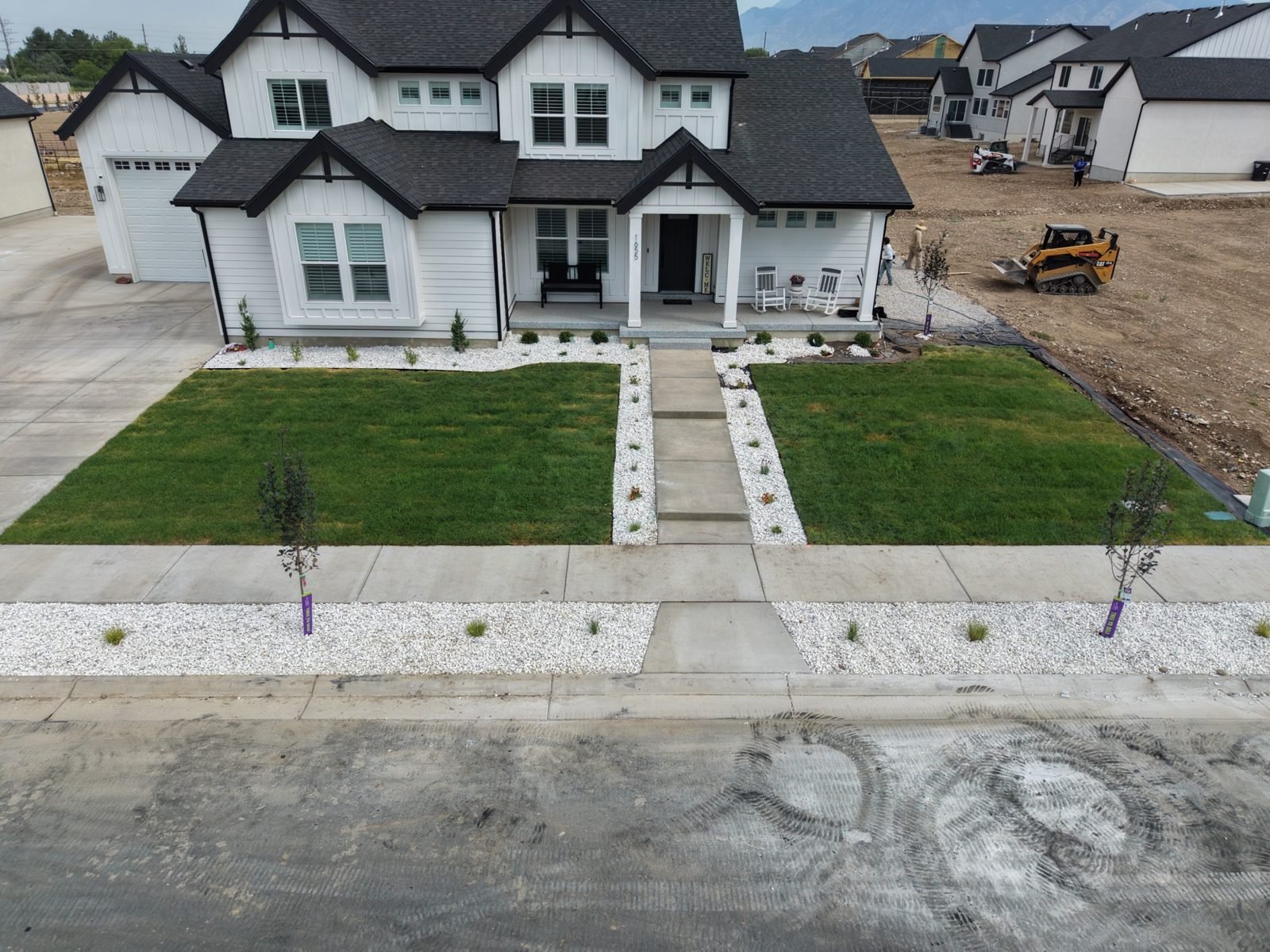
- Planning. A layout drawn to the HOA guidelines, with lawn, beds, trees, hardscape and the park strip placed, submitted to the architectural review committee where one exists.
- Grading and drainage. Rough grade, excavation and dirt haul off, topsoil, final grade, and French drains, dry wells or pop up drains so water runs away from the foundation.
- Irrigation. A zoned sprinkler system with heads, valves and a controller designed for the city's pressurized irrigation where available, and drip lines for beds, trees and the park strip.
- Sod. Topsoil, final grade and fresh sod for the lawn areas, with care instructions for the first weeks.
- Planting. Trees, shrubs and perennials chosen for Utah County summers and the HOA plant list, in rock or mulch beds over fabric with drip.
- Hardscape. Concrete curbing between lawn and beds, paver or concrete patios and walkways, boulders and natural stone steps.
- Retaining walls. Block or boulder walls where a lot has a slope to hold.
- Lighting. Low voltage landscape lighting on paths, trees and the house.
What drives the price up or down
| Driver | Why it moves the number |
|---|---|
| Lot size | Every square foot of lawn is sod, topsoil and irrigation coverage. A quarter acre and a half acre are different jobs. |
| Lawn versus rock and beds | Turf costs more to install and to water than a rock bed with drip. Water wise layouts often cost less up front and much less every month. |
| Slope | Retaining walls, terraces and extra drainage. The single biggest difference between a valley lot and a bench lot in Elk Ridge, Woodland Hills or Mapleton. |
| Sprinkler zones | Set by the water pressure and the layout, not by wish. More zones means more valves, more pipe and more trenching. |
| Drainage | A flat lot that holds water needs drains before anything else. Ignoring it is how new sod dies and basements get wet. |
| Curbing | Priced by the linear foot. More bed edge means more curbing. |
| Trees and plant size | A one inch caliper tree and a two inch caliper tree are very different prices. Plant counts are set by the HOA minimums and the owner's wishes. |
| Patios, walkways, walls | Hardscape is the most expensive square footage in a yard and the most durable. |
| Lighting | Priced per fixture plus the transformer and wire. |
| Access | A lot the skid steer can reach from the street costs less to work than one it cannot. |
Three typical lots, by scope
Dollar figures depend on the lot and belong on the proposal. The scope is what a homeowner can compare in advance.
A quarter acre production lot, front and back
The most common new build lot in Salem, Spanish Fork and Payson. Rough grade already done by the builder. Scope: final grade and drainage, a sprinkler system in the range of a half dozen zones, sod in front and back, curbing along the beds, rock beds with drip along the house and the fence line, the HOA minimum trees and shrubs, and the park strip finished to the city standard. Most owners do the front first to meet the HOA deadline and the back the same season or the next.
A third acre lot with a slope
Typical of Mapleton, Elk Ridge and the Santaquin bench. Everything in the quarter acre scope plus a retaining wall or terrace, more drainage, more rock on the slope and less lawn, and a longer sprinkler run. The wall is often the largest single line.
A half acre custom lot
Mapleton, Woodland Hills and parts of Elk Ridge. Larger lawn areas, more irrigation zones, bigger caliper trees, a patio or outdoor living area, lighting, and sometimes a secondary water connection. These yards are usually phased across a season.
How to read a landscaping bid
A one number bid for a full yard is a guess. A usable proposal lists grading, drainage, irrigation by zone, sod by square foot, curbing by the foot, rock by the ton or yard, trees and shrubs by count and size, hardscape by square foot, lighting by fixture and cleanup, with exclusions stated and allowances marked as allowances. Roots proposals are built that way so the homeowner can line them up against another company's, line by line.
Allowances, exclusions and what is not in a landscaping bid
An allowance is a placeholder price for something not yet chosen, usually plants or a patio material. It is fine on a proposal as long as it is marked as one, because the real number can land above it. Roots marks allowances as allowances and fixes everything it can at the proposal stage so the final matches the first number.
Things that are usually outside a landscaping bid and worth asking about by name: the fence, which is a separate trade; the driveway and front walk, which the builder pours; a shed or play structure; the builder's landscaping deposit, which the homeowner recovers from the builder; the water connection fee, which the city charges; and any maintenance after handoff, which Roots does not sell. A bid that is silent on these is not wrong, but the homeowner should know they are not in it.
Trees are the line most often cut to lower a bid and most often regretted. HOA minimums set the count; caliper size sets the price and the look. A smaller tree costs less and catches up in a few seasons, which is a reasonable trade on a tight budget and a poor one on a lot the family plans to keep for twenty years.
The cost of waiting
Most new neighborhoods in south Utah County give a new owner a fixed window to finish the front yard, and fines or extension requests follow a missed deadline. A plan written to the guidelines and a scheduled install date are usually cheaper than the alternatives. The new construction guide covers deadlines, builder deposits and the best months to install.
Landscaping cost by city
The pricing method is the same across all eight cities and travel is built into the schedule, not the price. City pages cover lots, water and HOAs: Salem, Spanish Fork, Springville, Mapleton, Elk Ridge, Woodland Hills, Payson and Santaquin.
Questions people ask
How much does landscaping cost in Utah?
It depends on lot size, slope, how much lawn versus rock, the number of sprinkler zones, curbing, trees and any patio or wall. Roots Landscaping prices every yard from a line item proposal after a site walk, and the price is fixed once signed. Published per unit ranges are being confirmed by the company.
How much does sod cost installed in Utah?
Sod is priced by the square foot installed, including topsoil and final grade, on the Roots proposal. The lawn area and the access to it set the number. Roots does not publish a flat per square foot sod price because the prep under it varies by lot.
How much does a sprinkler system cost for a new home?
Sprinkler systems are priced by zone on the Roots proposal, and the zone count is set by the water pressure and the layout, not chosen. Systems in south Utah County are designed for the city's pressurized irrigation where it is available.
Does Roots do DIY or prep only packages?
Roots installs complete yards on new construction lots. The company has moved away from prep only work. A homeowner who wants to do part of the yard should ask what the company can price and what it recommends leaving to a crew.
Is rock cheaper than grass?
Usually, both to install and to water. A water wise front yard with rock beds, drip and a smaller lawn is common in south Utah County and accepted by most HOAs, and the state and local water districts offer rebates for some of it.
Call (435) 677-6050 to book a site walk. Roots prices every yard from a line item proposal after seeing the lot.
Call (435) 677-6050